

A Zimbabwean Visual Language of People, Culture and Human Behaviour
Zimbabwean contemporary artist Keith Zenda has developed a body of work that is remarkably varied. At first sight, his portraits, historical paintings, totem works, scenes of everyday life and more imaginative compositions can appear to belong to quite different worlds.
Look more closely, however, and connections begin to emerge.
Again and again, Zenda returns to questions about people: how we behave, where we come from, what we value, how we treat one another and how our culture and surroundings shape us.
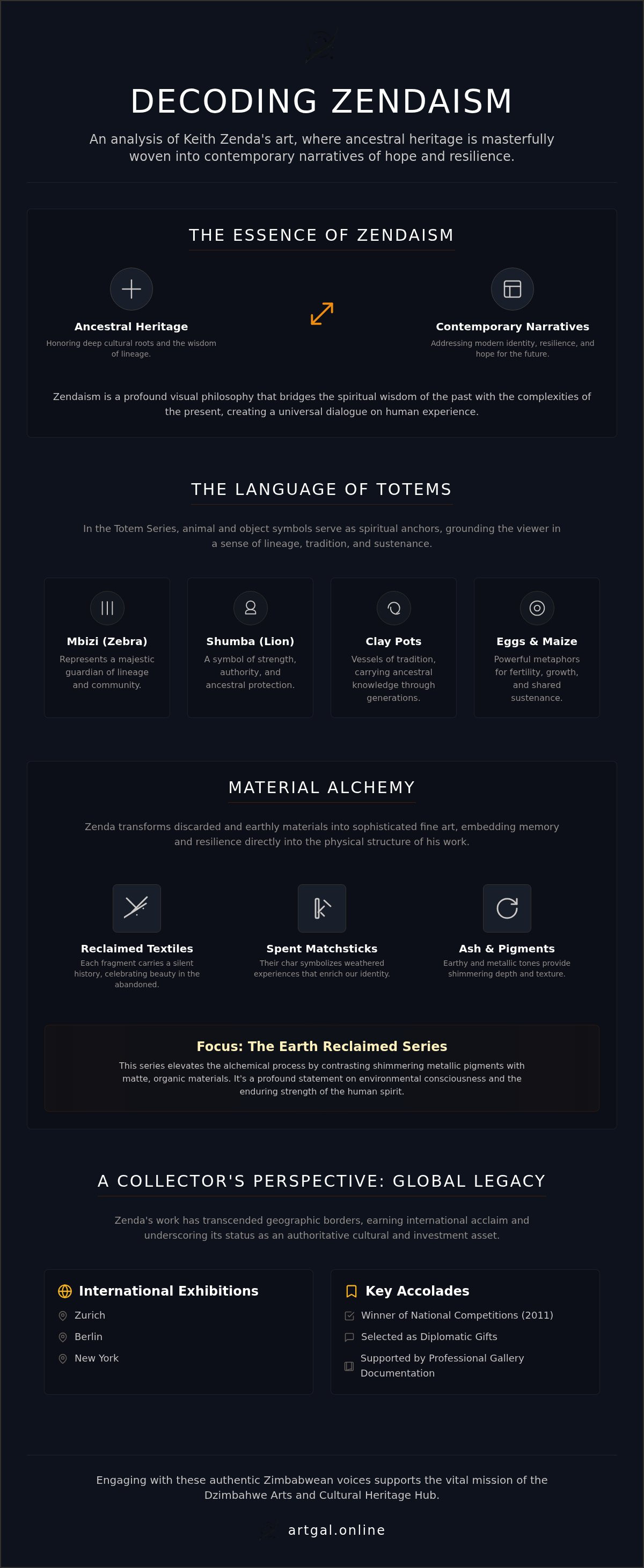
This evolving artistic philosophy has become known as Zendaism.
Zendaism is not a rigid style requiring every painting to look alike. Nor does every object in a Zenda painting need to carry a complicated hidden meaning.
It is better understood as Keith Zenda's developing visual language — one rooted firmly in Zimbabwean life and culture but used to explore questions that are recognisable far beyond Zimbabwe.
Key Takeaways
- Zendaism is Keith Zenda’s evolving artistic philosophy, using distinctly Zimbabwean imagery to explore universal questions about identity, community, human behaviour and belonging.
- Zimbabwean culture is central to Zenda’s work. Totems (mutupo), Ubuntu, figures such as Mbuya Nehanda, and references to ancestry and history connect his contemporary paintings with Zimbabwe’s cultural heritage.
- Zenda moves between everyday reality and imagination. Portraits of ordinary Zimbabwean life sit alongside historical, symbolic and mystical works, creating a visual record that encompasses both the Zimbabwe he observes and the world he imagines.
- Experimentation is becoming a hallmark of his art. Zenda paints on reed mats, incorporates real cloth and headdresses, reuses materials, and allows robes to extend beyond the canvas—challenging where a painting begins and ends.
Human Nature Told Through Simple Stories
One of the most distinctive aspects of Zendaism is Keith's ability to build an idea around an apparently simple situation.
In one work, small human figures struggle over a single cob of maize. The scene can be read as a comment on competition, survival and the way limited resources are distributed.
In another, tiny people flee from a cooking pot.
There is humour in such images, but also an uncomfortable reversal of perspective. Humans normally imagine themselves to be in control. Zenda changes the scale and suddenly makes us small and vulnerable.
This is an important part of Zendaism.
Rather than telling viewers what they must think, Zenda creates situations that encourage them to stop and consider human behaviour from a different angle.
The Zimbabwean setting may be specific, but the questions are universal.
Totems: Identity, Family and Zimbabwean Culture
To understand another part of Zenda's work, it is important to understand the significance of totems in Zimbabwean culture.
Within Shona culture, the mutupo, or clan totem, is connected with ancestry, family identity and lineage. Animals including Shumba (lion), Mbizi (zebra) and others can therefore carry meanings extending far beyond their appearance as wildlife.
For someone unfamiliar with Zimbabwean culture, a zebra in a painting may simply be an African animal.
For a Zimbabwean viewer, the same animal can evoke family, ancestry and belonging.
Zenda's exploration of totems allows him to introduce these elements of Zimbabwean identity into contemporary painting.
We should nevertheless resist the temptation to give every animal in every Zenda painting a spiritual explanation. Sometimes an animal is simply part of the subject.
What is significant is that Zenda works within a culture in which these symbols can possess additional layers of meaning.
Mbuya Nehanda: Bringing History Into the Present
Zendaism also looks backwards.
Among the important Zimbabwean personalities painted by Keith Zenda is Mbuya Nehanda, whose place in Zimbabwean history extends far beyond conventional portraiture.
Nehanda Charwe Nyakasikana became associated with resistance to colonial rule during the First Chimurenga of 1896–97. Following her execution in 1898, she became an enduring symbol of resistance and Zimbabwean identity.
When a contemporary Zimbabwean artist paints Mbuya Nehanda, he is therefore not simply reproducing the likeness of an important historical person.
He is bringing Zimbabwe's historical memory into the present.
This concern with memory, identity and continuity fits naturally into Zendaism. To understand who people are today, Zenda repeatedly looks at the culture, people and events that helped shape them.
The Zimbabwe of Everyday Life
But Keith Zenda does not only paint symbols and historical personalities.
A substantial part of his work comes from the world immediately around him.
Women, children, workers, families, township scenes, transport and people simply going about their lives appear throughout his paintings.
These everyday portraits are important because they show another Zimbabwe — not the Zimbabwe of tourist imagery, wildlife brochures or international headlines, but the country experienced by people living there.
A hairstyle, a dress, a street, a vehicle or the way people gather together can tell a story.
Individually these paintings portray moments.
Collectively, they begin to form a visual record of contemporary Zimbabwean life, and for those who appreciate how different artistic mediums document cultural history, you can explore The Slim Aarons Collection at Galerie Prints to discover an iconic visual archive of a different era.
Women, Land and Ubuntu
Women occupy a particularly important position within Zenda's work.
His Mushamukadzi works and numerous other paintings explore women as mothers, workers, individuals and central figures within community life.
In some compositions, female figures appear almost to merge with the surrounding landscape.
The relationship between people, community and the land is closely connected to another influence within Keith's work: Ubuntu — the idea that an individual's existence is inseparable from the community around them.
This helps explain why Zendaism is rarely simply about an isolated individual.
Even when Keith paints one person, that person frequently appears connected to a wider story involving family, ancestry, culture, community or environment.
The Mystical Portraits
There is also a more mysterious side to Zenda's work.
Some portraits move beyond straightforward representation. Their unusual figures, elaborate dress, symbolic objects and sometimes dreamlike atmosphere make them difficult to place entirely within everyday reality.
These can reasonably be described as Zenda's mystical portraits.
They may suggest ancestry, memory, imagination or spirituality, but their attraction partly comes from not explaining everything.
That distinction is important.
Zendaism should invite interpretation rather than manufacture explanations for every element of a painting.
Sometimes Keith leaves us with a question.
And the unanswered question can be more powerful than an explanation.
Cloth Becomes Part of the Painting
Zenda's experimentation does not stop with subject matter.
He increasingly questions the physical boundaries of a painting itself.
In some works he incorporates real cloth, particularly in headdresses and clothing. Instead of merely painting the texture of fabric, he introduces the actual material into the artwork.
This creates a fascinating meeting point between image and object.
The painted person exists within the canvas, while the fabric exists physically in the viewer's world.
When the Robe Leaves the Canvas
Zenda takes this idea even further in paintings where the clothing of a figure does not stop at the edge of the artwork.
A robe can physically fall beyond the bottom of the painting.
It is a deceptively simple idea with a striking effect.
The conventional rectangular canvas says: the artwork ends here.
Zenda's figure refuses to obey.
The person effectively steps out of the painted space and into the space occupied by the viewer.
This experimentation with the boundary between painting and physical object may prove to be one of the particularly recognisable aspects of Zenda's developing work.
Painting on Reed Mats
Canvas itself is not sacred to Zenda.
He has also experimented with painting on traditional reed mats.
This changes the work immediately. A reed mat already has texture, structure and its own relationship with Zimbabwean daily life before any paint is applied.
The artist cannot completely control or erase that surface. He has to work with it.
The resulting object therefore becomes something between painting, traditional material and contemporary mixed-media artwork.
This experimentation is particularly interesting because Zenda does not need to import an exotic material to make his work different.
He takes something familiar from his own environment and asks whether it can become part of contemporary fine art. For those who wish to follow in this spirit of experimentation using professional-grade supplies, learn more about Art Parts Fine Arts for a wide range of specialized materials.
Waste, Reuse and New Value
This approach can also be seen in Keith's experimentation with discarded materials.
Used cloth and other objects can acquire a second existence within an artwork.
There is naturally a sustainability aspect to this, but it would be a mistake to make environmentalism the explanation for all of Keith's work.
Something more fundamental is happening.
Zenda is questioning value.
Why is one material valuable and another considered waste?
Why is one object suitable for fine art and another not?
And can something that has lost its original purpose acquire a completely new value through creativity?
These questions fit remarkably well within the wider philosophy of Zendaism and its examination of human behaviour and perception.
Zimbabwean in Origin, Universal in Question
This is perhaps where Zendaism becomes most interesting.
Its vocabulary is unmistakably Zimbabwean:
Mbuya Nehanda. Mutupo. Shumba. Mbizi. Maize. Reed mats. Zimbabwean women. Township life. Rural landscapes. Ubuntu.
But the questions behind the images are not confined to Zimbabwe.
Who are we?
Where do we belong?
Why do people compete?
How do we share resources?
What do we discard?
What do we remember?
What do we inherit from those who came before us?
And what will we leave to those who follow?
Defining Zendaism
Zendaism can therefore be understood as Keith Zenda's evolving artistic philosophy for examining human behaviour, identity and community through a distinctly Zimbabwean visual language.
It brings together several strands of his work:
- Zimbabwean history and important personalities
- totems, ancestry and cultural identity
- Ubuntu and community
- portraits and observations of everyday Zimbabwean life
- women and their relationship with family, society and land
- metaphorical stories about human behaviour
- mystical and imaginative portraiture
- unconventional materials including cloth and reed mats
- experimentation beyond the traditional boundaries of the canvas
Not every Zenda painting needs to contain all of these elements.
That is precisely the point.
Zendaism is not a formula. It is a way of thinking.
An Artistic Language Still Developing
Keith Zenda's career is still evolving, and that makes documenting Zendaism particularly important.
Artgal.Online is not attempting to retrospectively impose a grand theory on every painting he has produced. Its role is to document the connections that are becoming increasingly visible across his work: his subjects, techniques, cultural references, experiments and the stories behind individual paintings.
That documentation is important for collectors because an artist's development cannot be understood from a single painting.
One painting shows us an artwork. A body of work shows us an artist.
And in Keith Zenda's case, that body of work reveals an artist looking simultaneously in several directions — towards Zimbabwe's ancestors and history, towards the people living around him today, towards the natural and cultural environment, and towards his own imagination.
That may ultimately be the essence of Zendaism:
Deeply Zimbabwean in its roots, experimental in its expression, and universal in the questions it asks..

Article by
Artgal.Online Editorial Team
The Artgal.Online Editorial Team works closely with artists, curators, researchers, and collectors to produce authoritative articles on contemporary African art, Zimbabwean culture, Shona sculpture, collecting, and exhibitions. Articles are reviewed in collaboration with the artists whenever possible to ensure authenticity and accuracy.
Disclaimer
The information presented in these articles, guides, infographics and educational resources is intended for general informational and educational purposes only. While every effort is made to ensure accuracy, completeness and relevance, Artgal.Online and its contributors do not guarantee that all information reflects the most current market conditions, auction results, valuations or scholarly opinions. Opinions expressed are those of the author and are provided to encourage appreciation, understanding and discussion of Zimbabwean and contemporary African art. This content should not be considered financial, legal, tax or investment advice. Readers are encouraged to conduct their own research and seek professional guidance where appropriate. References to artists, artworks, markets or collecting trends are intended for educational purposes and do not constitute a guarantee of future value or investment performance.


