

Interest in contemporary African art has grown considerably over the past decade, bringing artists from across the continent to the attention of international collectors, galleries and museums.
Yet for a collector discovering this field from Europe, America or Asia, one question remains particularly important: how do you distinguish an artist with a developing body of work and genuine cultural relevance from art produced primarily for the tourist market?
At **Artgal.Online **, this question is especially important to us.
We work directly with artists in Zimbabwe and have followed the development of individual careers, artistic styles and bodies of work over many years. Through Artgal.Online in Switzerland and the Artgal Zim Center in Domboshava, Zimbabwe, our aim is not simply to offer artworks for sale.
We want collectors to understand who created the work, where it came from, what influenced it and where it sits within the artist's wider development.
For us, collecting emerging African art begins with the artist and the story — not with speculation about what an artwork might be worth tomorrow.
Why Contemporary Zimbabwean Art Deserves Attention
Zimbabwe occupies an unusual position within African art.
Internationally, the country is particularly recognised for its tradition of stone sculpture, often broadly described as Shona sculpture. Generations of sculptors have transformed Zimbabwe's extraordinary indigenous stones into works exploring humanity, spirituality, family, ancestry and the natural world.
But Zimbabwean creativity extends far beyond sculpture.
A growing generation of painters is developing highly individual approaches to portraiture, abstraction, everyday life, cultural memory, wildlife and the rapidly changing society around them.
For collectors, this creates an opportunity to discover artists while their careers and artistic languages are still developing.
That does not mean that every emerging artist will become internationally recognised, nor should art be treated as a guaranteed financial investment.
Major international institutions have increasingly incorporated artists from Africa and the African diaspora into exhibitions, research and collections, contributing to a broader understanding of contemporary African art.
Art should first be collected because the work matters to you.
What can be evaluated, however, is the seriousness of an artist's practice.
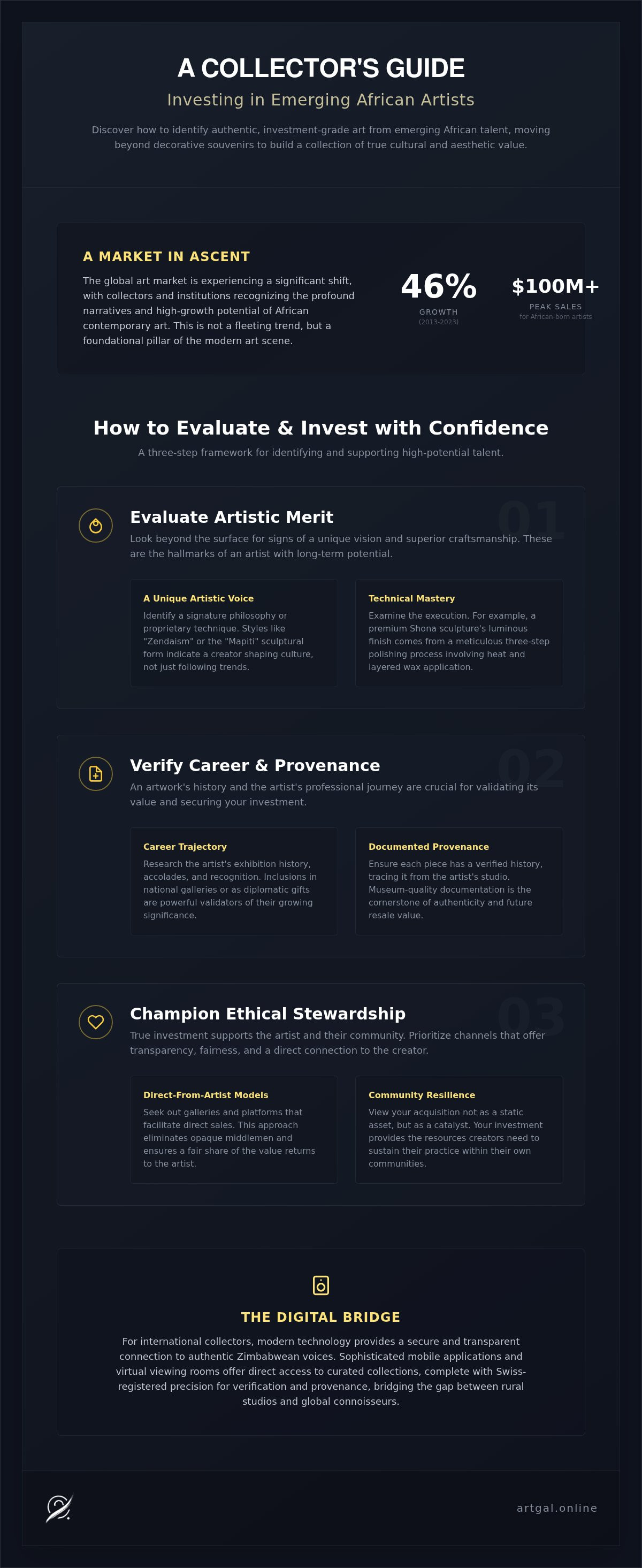
How We Evaluate an Emerging Artist
One of the first things we look for is a recognisable artistic language.
An artist should gradually develop something that distinguishes their work from that of others. Technique is important, but technique alone does not create an artistic identity.
**Keith Zenda ** provides a good example. Over many years, recurring ideas, symbols and ways of representing people, heritage and contemporary Zimbabwean life have developed into an increasingly recognisable artistic language.
The same can be seen in sculpture.
**Sampson Kuvenguhwa ** developed his highly individual Mapiti style, with its elongated forms, distinctive faces, negative spaces and carefully formed hands and feet.
Over decades, those forms evolved, becoming softer and increasingly organic before contributing to the development of his later **Dry Tree style **, inspired by the structures and formations found in weathered trees, bark and roots — while always remaining sculpture carved entirely from stone.
Such development is important because it demonstrates that an artist is not simply repeating an attractive object.
There is an artistic journey. A Journey through Stone, Spirit and Time.
Look Beyond the Individual Artwork
When considering an emerging artist, we encourage collectors to ask broader questions.
Has the artist developed a consistent body of work? Has that work evolved? Has the artist exhibited publicly? Have galleries, cultural organisations or institutions shown interest? Has the artist received meaningful recognition? Can the gallery explain when and why a particular work was created?
These questions can often tell you considerably more than an asking price.
An artwork should ideally be understood within the artist's career.
A painting from an early period may reveal the beginnings of an idea developed many years later. A sculpture may belong to a particular stylistic period.
Understanding these relationships transforms collecting from simply purchasing an attractive object into documenting part of an artist's creative history. For collectors who prefer to organize this data and history using professional spreadsheets, check out Biz Infographs for advanced Excel tips and dashboard templates.
Provenance and Authenticity Matter
As interest in African art grows, provenance becomes increasingly important.
Collectors should know where an artwork came from and, wherever reasonably possible, its relationship to the artist or their recognised representative.
At Artgal.Online, we place particular emphasis on documenting the works and artists we represent. Original artworks are accompanied by appropriate information and certification, helping establish a record that can remain with the artwork as it passes from one generation to another. To ensure these documents and catalogues reflect the quality of the art itself, professional litho and digital production services are often utilized; learn more about the high-quality solutions from Print It ZA print and packaging.
This is especially important with Zimbabwean stone sculpture, where unsigned, incorrectly attributed or poorly documented works can circulate internationally.
A signature alone is not always sufficient.
Knowledge of an artist's technique, stylistic development, materials and history can be equally important when establishing attribution.
Shona Stone Sculpture: Look at the Stone as Well as the Artist
Zimbabwean sculpture has another extraordinary participant in the creative process: **the stone itself **.
Different stones possess different colours, structures, hardness and natural markings. Sculptors may deliberately leave areas raw while polishing others, creating a dialogue between the natural surface of the stone and the form created by the artist.
Polishing can reveal colours and patterns that are almost invisible when the stone is first quarried.
But collectors should be careful about judging quality simply by how highly polished a sculpture is. Some artists intentionally leave significant areas textured, rough or apparently unfinished because these surfaces form part of the artistic language.
With Sampson Kuvenguhwa's later work, for example, rough and weathered textures can be fundamental to the sculpture, particularly where the stone is used to evoke the appearance of bark, roots or an ageing tree.
The question is therefore not simply:
“How well is this polished?”
It is:
“Why has the artist treated the stone this way?”
Supporting Artists Rather Than Simply Buying Objects
For Artgal, collecting also involves responsibility.
When collectors acquire work through channels closely connected to the artists, their purchases can contribute directly to sustaining artistic careers.
This philosophy is an important part of the development of the Artgal Zim Center in Domboshava.
The Center provides a physical place in Zimbabwe where artists can work, exhibit, exchange ideas and participate in educational and cultural initiatives.
Established artists can interact with younger talent, while exhibitions and competitions create opportunities for artists who may otherwise have limited access to the international art world.
Our objective is therefore larger than selling individual paintings or sculptures.
We want to contribute to an environment in which Zimbabwean artists can continue developing in Zimbabwe, while their work becomes increasingly accessible internationally.
Technology Can Bring the Collector Closer to the Artist
Geography once made discovering emerging African artists considerably more difficult.
Today, digital exhibitions , detailed photography, video , virtual presentations and augmented-reality tools allow collectors thousands of kilometres away to understand an artwork far better before making a decision.
Artgal.Online uses these technologies to bring collectors closer to the work — but technology should support the artwork rather than replace it.
The original painting remains a painting.
The sculpture remains stone carved by the artist.
Digital presentation simply allows us to tell its story more effectively and give collectors greater access to artists whom they might otherwise never encounter.
Collecting With Knowledge
The strongest collection is not necessarily the collection containing the most expensive names.
It is often the one in which the collector understands why each work belongs there.
When considering an emerging Zimbabwean or African artist, look for originality, technical ability, development over time, provenance and a meaningful body of work.
Learn about the artist's background. Understand the cultural context without assuming that every African artwork must carry a spiritual meaning.
Some works concern ancestry and belief. Others concern motherhood, political or social change, landscape, humour, daily life, personal relationships or simply the artist's exploration of colour and form.
African art is not one story.
Neither is Zimbabwean art.
Increasing international scholarship is similarly examining African artists within their individual historical, cultural and artistic contexts.
That diversity is precisely what makes discovering it so rewarding.
Artgal.Online: Connecting Zimbabwean Artists With International Collectors
Artgal.Online is based in Switzerland and works closely with artists and cultural initiatives in Zimbabwe, including the Artgal Zim Center in Domboshava.
Our approach combines direct relationships with artists, documentation, exhibitions, digital viewing experiences and educational content designed to help collectors understand both the artwork and the person behind it.
We believe that an informed collector becomes more than a buyer.
The collector becomes part of the artist's story.
And when an emerging artist's work is collected, documented and preserved today, that collector may also be helping preserve a small part of Zimbabwe's cultural history for tomorrow.
Frequently Asked Questions
Is Emerging African Art a Good Investment?
Art should not be regarded as a guaranteed financial investment. Prices can rise or fall, and the future market for an individual artist cannot be predicted.
We encourage collectors to begin with artistic quality, personal connection, provenance and the artist's development.
Increased international attention towards contemporary African art can create opportunities, but cultural and aesthetic value should remain central to the decision.
How Can I Identify a Promising Emerging Artist?
Look beyond one attractive artwork.
Examine the artist's wider body of work, development over time, exhibition history, technical ability and whether they have created a recognisable artistic language.
Serious artists normally demonstrate progression rather than simply repeating commercially successful images.
Why Is Provenance Important When Buying African Art?
Provenance documents an artwork's history and helps establish authenticity.
This is particularly important for older sculptures and works by recognised artists. Documentation connecting an artwork to the artist, gallery or established collection can become increasingly important as the artist's career develops.
Can I Buy Zimbabwean Paintings and Sculptures Internationally?
Yes.
Artgal.Online connects international collectors with original contemporary paintings and Zimbabwean stone sculpture while providing information about the artist, artwork and provenance.
Works can be viewed digitally before acquisition, allowing collectors to discover Zimbabwean artists regardless of their location.
Does Buying Through Artgal Support Artists in Zimbabwe?
Our objective is to maintain close relationships with the artists we represent and to support the wider artistic environment in which they work.
Artgal.Online also supports the development and activities of the Artgal Zim Center in Domboshava, including exhibitions, artistic development and opportunities for emerging talent.
Key Takeaway
- - Learn to look beyond the distinction between tourist art and serious contemporary practice by considering an artist’s originality, technical ability, development, cultural context and provenance.
- - Discover how distinctive artistic languages — such as Keith Zenda ’s evolving philosophy of **Zendaism ** and Sampson Kuvenguhwa’s highly individual **Mapiti style** — can help identify artists with a consistent and developing body of work.
- - Approach collecting emerging African art through knowledge rather than speculation, focusing on authenticity, documentation, direct relationships and an understanding of the artist behind the work.
- - Explore how **Artgal.Online** connects international collectors with contemporary Zimbabwean artists through digital exhibitions, viewing rooms, detailed artist information and modern presentation technology.
- - Understand that collecting Zimbabwean art can be more than acquiring an object: it can help document an artist’s development, support living creative communities and preserve part of Zimbabwe’s evolving cultural story.
**Table of Contents**
Why Contemporary Zimbabwean Art Deserves Attention
How We Evaluate an Emerging Artist
Look Beyond the Individual Artwork
Provenance and Authenticity Matter
Shona Stone Sculpture: Look at the Stone as Well as the Artist
Supporting Artists Rather Than Simply Buying Objects
Technology Can Bring the Collector Closer to the Artist
Collecting With Knowledge
Artgal.Online: Connecting Zimbabwean Artists With International Collectors
Frequently Asked Questions

Article by
Artgal.Online Editorial Team
The Artgal.Online Editorial Team works closely with artists, curators, researchers, and collectors to produce authoritative articles on contemporary African art, Zimbabwean culture, Shona sculpture, collecting, and exhibitions. Articles are reviewed in collaboration with the artists whenever possible to ensure authenticity and accuracy.
Disclaimer
The information presented in these articles, guides, infographics and educational resources is intended for general informational and educational purposes only. While every effort is made to ensure accuracy, completeness and relevance, Artgal.Online and its contributors do not guarantee that all information reflects the most current market conditions, auction results, valuations or scholarly opinions. Opinions expressed are those of the author and are provided to encourage appreciation, understanding and discussion of Zimbabwean and contemporary African art. This content should not be considered financial, legal, tax or investment advice. Readers are encouraged to conduct their own research and seek professional guidance where appropriate. References to artists, artworks, markets or collecting trends are intended for educational purposes and do not constitute a guarantee of future value or investment performance.


