

A raw block of Zimbabwean serpentine isn't merely a piece of stone; it's a silent vessel waiting for a voice to speak through its ancient grain. You've likely stood before these fluid, obsidian-dark forms and felt a profound connection, yet perhaps you've also wondered how a human hand can coax such delicate emotion from a material so unyielding. Understanding the Shona sculpture making process is essential to appreciating why these works have captivated the global art world. It's a journey that begins long before the first chisel strike, rooted in a cultural heritage where the artist acts as a spiritual medium to release the form already residing within the rock.
Whether you're a seasoned collector or a curious newcomer, you deserve to know the difference between a soulful masterpiece and a hollow imitation. We'll guide you through the intricate technical steps, from the selection of dense springstone to the signature three-step polishing technique involving open-fire heating and natural wax. By exploring the intentionality behind every file mark and the spiritual traditions of the Dzimbahwe heritage, you'll gain the insight needed to identify authentic works that carry the true resonance of Zimbabwe's master carvers. Discover how these dedicated artists transform raw earth into timeless expressions of the human spirit.
Key Takeaways
- Understand the spiritual dialogue between artist and stone, where master carvers act as mediums to reveal ancestral forms hidden within raw serpentine.
- Learn to identify the hallmarks of authentic craftsmanship by exploring the labor-intensive Shona sculpture making process, from initial roughing to the delicate refinement of texture.
- Gain insight into the signature three-step polishing technique that uses open-fire heating and natural wax to bring out the stone's deep, lustrous colors.
- Discover how your appreciation for these works directly supports the Dzimbahwe Arts & Cultural Heritage Hub, fostering the next generation of Zimbabwean talent.
- Explore how to use the Artgal.Online Mobile App to experience these masterpieces through immersive virtual exhibitions and curated artist viewing rooms.
The Spiritual Genesis: How Shona Artists 'Listen' to the Stone
Explore the profound belief that every stone holds a spirit waiting for release. In Shona culture, the artist isn't merely a creator but a medium, a conduit between the physical world and the ancestral realm. This spiritual mediumship defines the Shona sculpture making process, where the carver waits for the stone to reveal its intended form. It's a patient, contemplative exchange. The artist listens to the whispers of the material, seeking a connection with forms that have waited centuries to be seen. This isn't a mechanical task; it's a sacred dialogue that requires the artist to set aside ego and follow the stone's lead.
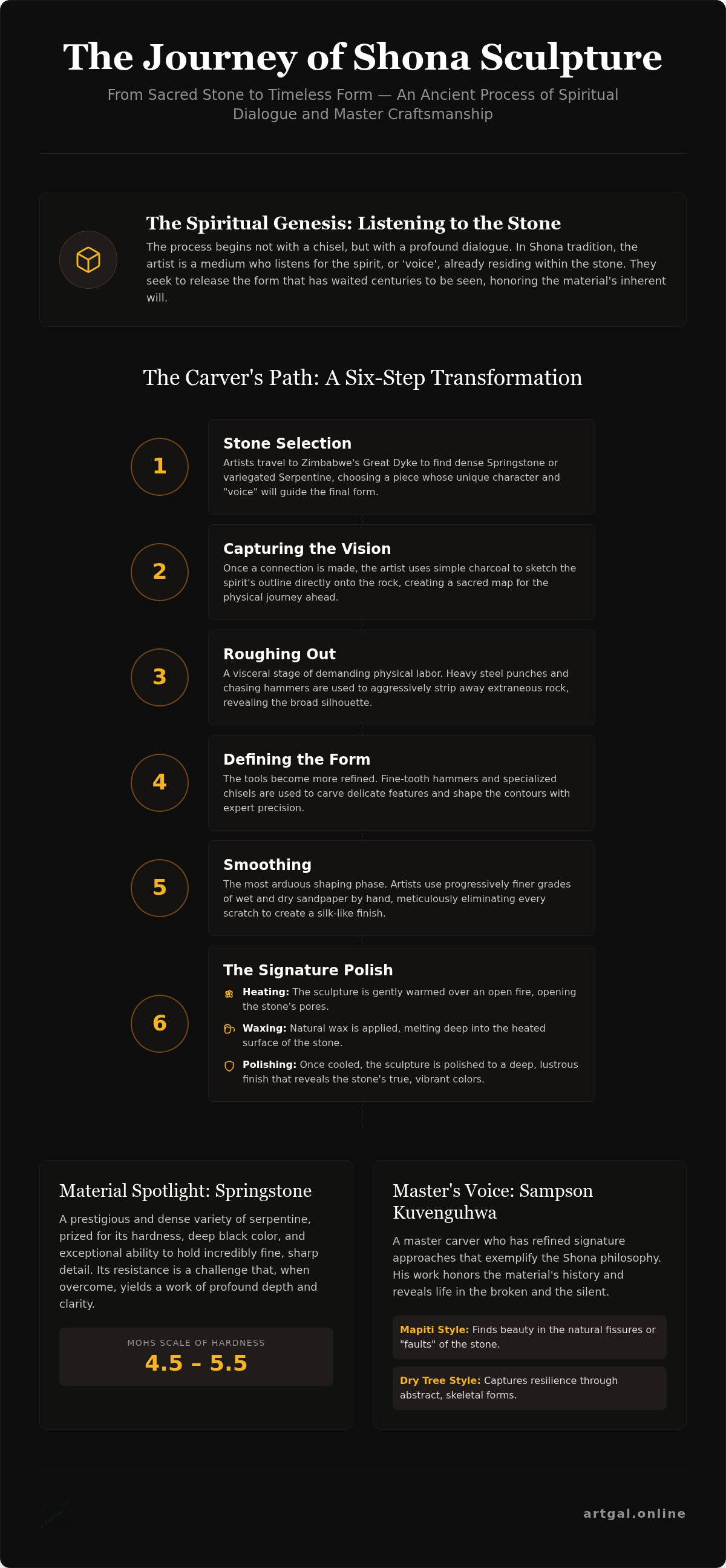
Selection is the first physical act of this sacred dialogue. Artists often travel to the Great Dyke, a mineral-rich ridge spanning Zimbabwe, to find the perfect Springstone or Serpentine. These stones are prized for their density and unique "voices." A hard, black Springstone might demand a powerful, stoic figure, while a variegated Serpentine suggests fluid, organic movement. Before the first strike of the hammer, the artist often uses a simple piece of charcoal to sketch the vision directly onto the rock, capturing the spirit's outline while it's still fresh in their mind. This sketch serves as a map for the journey ahead, ensuring the artist remains true to the stone's initial revelation.
Within this tradition, Sampson Kuvenguhwa has refined a signature approach known as the Mapiti style. He specializes in revealing life in the broken and the silent, often finding beauty in the natural fissures or "faults" of the stone. His work exemplifies the idea that the artist's hand should honor the material's history. By incorporating the stone's natural textures into the final piece, he ensures that the masterpiece feels like an inevitable revelation rather than a forced construction.
From Ancient Traditions to Modern Mastery
This artistic lineage isn't a recent phenomenon. It's deeply rooted in the history of Zimbabwean sculpture, tracing back to the iconic soapstone birds found at the Great Zimbabwe ruins. While those ancient works often served functional or symbolic roles within the kingdom, contemporary carvers have pushed the boundaries of the medium into the realm of high art.
Consider the "Dry Tree" style, another innovation by Kuvenguhwa. It represents a significant departure from traditional figural carving, moving toward pure artistic expression. Instead of depicting literal humans or animals, this style captures the essence of resilience and survival through abstract, skeletal forms. It's a testament to how the modern Shona sculpture making process continues to evolve, bridging the gap between ancient heritage and contemporary global aesthetics.
The Technical Journey: A Step-by-Step Guide to Shona Stone Carving
Once the spiritual vision is secured, the physical labor of the Shona sculpture making process begins in earnest. It's a demanding test of both strength and delicacy. The artist starts by "roughing out" the form, using a heavy steel punch and a chasing hammer to aggressively strip away extraneous rock. This initial stage is visceral and loud, as large shards of stone fall away to reveal the broad silhouette of the intended figure. It requires an intimate knowledge of the stone's grain to ensure that a single misplaced strike doesn't shatter the entire vision.
As the primary form takes shape, the tools become significantly more refined. The artist transitions from heavy hammers to fine-tooth hammers and specialized chisels to define features and smooth out the aggressive gouges left by the punch. Springstone, a dense and prestigious variety of serpentine, typically sits between 4.5 and 5.5 on the Mohs scale of mineral hardness, requiring expert precision to carve without causing internal bruising to the stone. This resistance is exactly what allows the material to hold such incredibly fine, sharp detail once the carving is complete.
The final stage of shaping is perhaps the most arduous: the smoothing phase. This isn't done with machines but with the artist's own hands, utilizing wet and dry sandpaper in progressively finer grades. Starting with a coarse grit and moving toward a silk-like finish, the artist rubs the stone under a constant stream of water to eliminate every scratch. If you're interested in witnessing how these technical steps culminate in a finished masterpiece, we invite you to connect with our curators for more information on our latest arrivals.
The Signature Three-Step Polishing Process
The transformation from dull grey rock to a lustrous masterpiece occurs through a traditional three-step polishing technique. First, the artist carefully heats the finished stone over an open fire. This heat expands the mineral's pores, preparing the surface to receive the finish. Next comes the alchemy of wax; a blend of natural oils and beeswax is applied to the hot stone, where it melts and penetrates deep into the surface. Finally, once the stone has cooled, it's buffed with a soft cloth to achieve a "skin-like glow" and the deep, saturated colors that characterize museum-quality Shona art.
Beyond the Sculpture: Preserving Heritage and Ethical Collecting
The completion of a masterpiece marks the end of the physical Shona sculpture making process, but for the artist and their community, it's the beginning of a vital economic and cultural cycle. Every work represented through our platform contributes directly to the Dzimbahwe Arts & Cultural Heritage Hub. This initiative provides essential resources, tools, and mentorship for rural youth, ensuring that ancient carving traditions remain a viable and celebrated path for future generations. By choosing authentic works, you aren't just acquiring art; you're investing in the resilience and continuity of a living heritage.
Ethical collecting requires a deep understanding of the months of labor invested in a single stone. Unlike mass-produced imitations found in tourist markets, a true Shona sculpture involves a slow, meditative engagement with the material that cannot be rushed. Fair compensation reflects this intensive commitment, acknowledging the artist's role as both a master craftsman and a spiritual guardian. You can learn more about how to support African artists through mindful acquisitions that prioritize provenance and direct representation over convenience.
Digital innovation has created a powerful bridge between rural Zimbabwe and the global stage. Through the Artgal.Online Mobile App, we provide a sophisticated platform where collectors can engage with the human element of creation. This technology removes traditional barriers of distance, allowing you to witness the environment and the people behind the work. It preserves the integrity of the Shona sculpture making process by ensuring that the narrative remains in the hands of the creators themselves, providing a transparent window into the artist's world.
Discovering Authentic Shona Sculpture Artist Stories
For the modern collector, provenance is as significant as the aesthetic itself. Understanding an artist's biography, their specific stylistic lineage, and the personal history of a piece adds layers of meaning that a mass-produced item can never replicate. Our digital viewing rooms are designed to provide this essential context, offering high-resolution perspectives that allow you to feel the scale and unique texture of hand-carved stone from your own home. Explore our curated collection in the Artgal.Online viewing rooms, where each sculpture tells a story of heritage, spirit, and survival.
Bringing the Ancestral Stone into Your Home
The journey from a raw block of serpentine to a polished masterpiece is a profound testament to the patience and spiritual depth of Zimbabwe's master carvers. By understanding the intricate Shona sculpture making process, you move from being a mere observer to a knowledgeable custodian of a deep cultural tradition. You've seen how artists like the award-winning Sampson Kuvenguhwa act as mediums for the stone, and how every hand-finished detail contributes to the vital work of the Dzimbahwe Arts & Cultural Heritage Hub. This connection ensures that the legacy of stone carving continues to thrive among rural youth.
Frequently Asked Questions
What is the most common stone used in the Shona sculpture making process?
Serpentine is the primary material utilized in the Shona sculpture making process, prized for its remarkable range of colors and geological stability. Within this mineral family, master carvers frequently select hard varieties like springstone for its deep black finish or fruit serpentine for its variegated greens. These stones are traditionally sourced from the Great Dyke region, providing a dense medium that can withstand the rigorous striking required to reveal the spirit within.
How long does it take to complete a hand-carved Shona stone sculpture?
The duration of the Shona sculpture making process typically spans several weeks to several months of intensive labor, depending on the stone's hardness and the complexity of the form. A smaller, less intricate piece might be finished in roughly two weeks, whereas a large scale masterpiece can take months to smooth and polish by hand. This deliberate pace ensures that the artist remains in constant dialogue with the stone's natural grain.
Why is heat used during the finishing and polishing of Zimbabwe stone art?
Artists use heat to open the microscopic pores of the stone, which allows a natural wax or oil blend to be absorbed deep into the mineral. By carefully warming the piece over an open fire, the carver creates a permanent bond between the finish and the stone. It's this traditional technique that brings out the vibrant, hidden colors of the serpentine and produces the lustrous, skin-like glow that defines museum-quality Zimbabwean art.
What is the difference between authentic Shona sculpture and mass-produced 'airport art'?
Authentic Shona sculpture is defined by its unique spiritual narrative and hand-finished intentionality, whereas "airport art" is often mass-produced using power tools and repetitive designs. True masterpieces carry a verifiable provenance and reflect a specific artist's stylistic signature, such as the Mapiti or Dry Tree styles. Choosing authentic work ensures that your acquisition supports sustainable community initiatives like the Dzimbahwe Arts & Cultural Heritage Hub rather than commercial, factory-style production.

Article by
Artgal.Online Editorial Team
The Artgal.Online Editorial Team works closely with artists, curators, researchers, and collectors to produce authoritative articles on contemporary African art, Zimbabwean culture, Shona sculpture, collecting, and exhibitions. Articles are reviewed in collaboration with the artists whenever possible to ensure authenticity and accuracy.
Disclaimer
The information presented in these articles, guides, infographics and educational resources is intended for general informational and educational purposes only. While every effort is made to ensure accuracy, completeness and relevance, Artgal.Online and its contributors do not guarantee that all information reflects the most current market conditions, auction results, valuations or scholarly opinions. Opinions expressed are those of the author and are provided to encourage appreciation, understanding and discussion of Zimbabwean and contemporary African art. This content should not be considered financial, legal, tax or investment advice. Readers are encouraged to conduct their own research and seek professional guidance where appropriate. References to artists, artworks, markets or collecting trends are intended for educational purposes and do not constitute a guarantee of future value or investment performance.


