
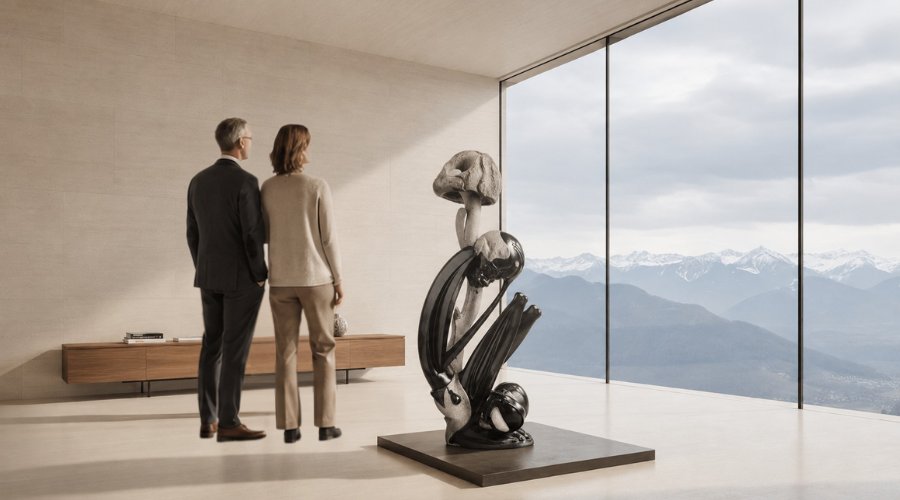
What if the stone beneath your hand isn't merely a cold mineral, but a vessel holding a spirit that has waited centuries to be released? You likely understand the quiet frustration of seeking a profound connection with a hand carved African sculpture, only to find yourself questioning if a piece is a mass-produced imitation or a genuine labor of love. It's often difficult to navigate the subtle nuances between various regional styles or to fully grasp the spiritual weight behind a specific form.
This exploration invites you to discover the sacred heritage and masterful techniques that define these works, providing the clarity you need to curate with confidence. We'll examine the distinct characteristics of wood and stone traditions, walk through the intentional stages of the Shona carving process, and learn how to identify the hallmarks of a true masterpiece. By the end of our journey, you'll see these works not just as objects, but as vibrant bridges to a rich cultural history that deserves your focused attention.
Key Takeaways
- Explore the geological heritage of Zimbabwe's Great Dyke to understand how specific minerals provide the foundation for every authentic hand carved African sculpture.
- Discover the spiritual philosophy of the Shona masters, where the artist listens to the raw stone to reveal its inherent form and narrative.
- Learn the specific technical stages of the carving process, from the initial roughing out with chisels to the signature three-step polishing that creates a luminous glow.
- Develop the discerning eye of a curator by identifying subtle tool signatures and surface textures that separate handcrafted masterpieces from mass-produced imitations.
Understanding the Heritage and Materials of Hand-Carved African Sculpture
A hand carved African sculpture is rarely a mere object of decoration; it's a deliberate act of cultural storytelling and a profound vessel for spiritual expression. This rich African sculpture heritage spans centuries, yet it finds a particularly powerful contemporary voice in the highlands of Zimbabwe. The geological heart of this movement lies within the Great Dyke, a massive mineral-rich ridge that offers a diverse palette of stones for the master carver.
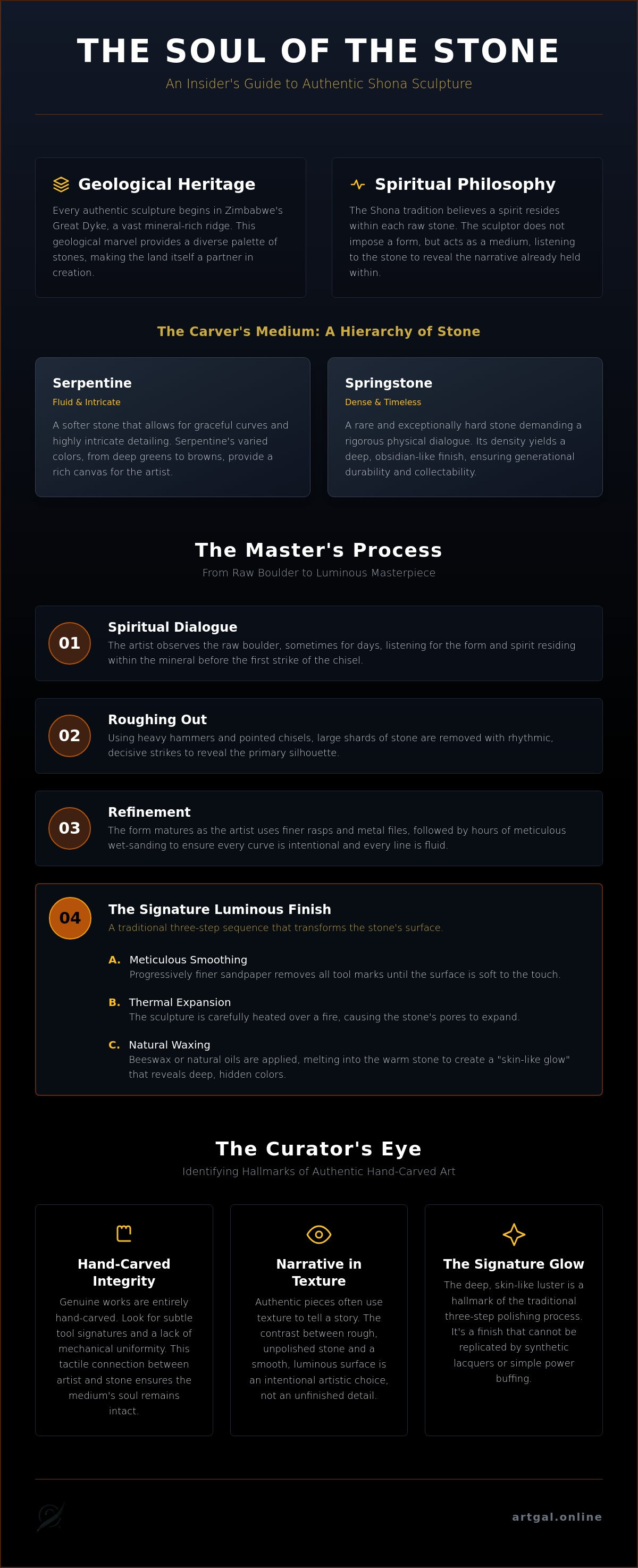
The choice of medium is both a technical and spiritual decision. Artists work with a hierarchy of materials that dictates the final resonance of the piece. Soft Serpentine allows for fluid, intricate detailing, while the rare and exceptionally dense Springstone demands a more rigorous physical dialogue. This harder stone produces a deep, obsidian-like finish that ensures the work's durability for generations, making it a favorite for collectors seeking timeless quality.
For collectors who wish to curate a cohesive space, you can learn more about Artistry Deco Shop to find functional art and home accessories that complement a modern interior.
The Shona Tradition: More Than Just Stone
Central to this art is the philosophy of 'hunhu' or 'ubuntu', which emphasizes our shared humanity and communal connection. This worldview transforms Shona stone sculpture from an individual pursuit into a collective celebration of heritage. It's recognized globally as a premier fine art movement, bridging the gap between ancient traditions and modern aesthetic sensibilities through its sophisticated, abstract forms.
Spiritual Mediumship: The Artist as a Vessel
In this tradition, the sculptor doesn't impose a form upon the stone. Instead, they act as a medium. There's a deep-seated belief that a spirit already resides within the raw boulder, waiting for the artist to release it. Master carver Sampson Kuvenguhwa often describes his work as giving life to the 'forgotten and silent'. By listening to the stone's grain and weight, the artist reveals a form that was always there, hidden beneath the surface, waiting for the first strike of the chisel.
The Master’s Process: How Shona Stone Sculptures are Created
The journey of a hand carved African sculpture begins with a moment of profound stillness. The artist observes a raw boulder, sometimes for days, seeking to understand its internal fissures and hidden potential. This isn't just a search for quality; it's a spiritual dialogue where the master 'listens' for the form residing within the mineral. Once the vision is clear, the roughing out phase commences. Using heavy hammers and pointed chisels, the sculptor removes large shards of stone with rhythmic, decisive strikes to find the primary silhouette.
As the form matures, the work transitions into a delicate refinement stage. The artist uses finer rasps and metal files to smooth the surface, followed by hours of wet-sanding with progressively finer grit. This meticulous Shona stone carving process ensures that every curve is intentional and every line is fluid. Texture is often used to tell a story; for example, the contrast of rough and smooth surfaces in the 'Dry Tree Style' highlights the resilience of nature, a technique we discuss in our Shona sculpture artist stories.
The Signature Three-Step Polishing Secret
To achieve the luminous finish characteristic of Zimbabwean art, masters follow a traditional sequence that transforms the stone's surface:
- Meticulous smoothing: The artist uses progressively finer sandpaper to remove all tool marks until the surface is soft to the touch.
- Thermal expansion: The sculpture is carefully heated over an open fire to expand the pores of the mineral.
- Natural waxing: Beeswax or specialized oils are applied, melting into the stone to create a 'skin-like glow' that reveals deep, hidden colors.
Tools of the Trade: Traditional vs. Modern
While some modern workshops utilize power tools for speed, the most prestigious works remain entirely hand-carved. Traditional handmade chisels and rasps allow the artist to feel the stone's resistance, ensuring the medium's soul remains intact. This tactile connection is what defines the quality of a genuine hand carved African sculpture, preserving the artist's original intent. If you're curious about how these techniques bring a specific vision to life, we invite you to speak with our curators about the origins of our current collection.
Curating Your Collection: How to Identify Authentic Hand-Carved Art
Authenticity also rests in the artist’s unique voice and lineage. A prime example is the Mapiti Style, a distinct aesthetic pioneered by Sampson Kuvenguhwa that blends traditional Shona themes with sophisticated contemporary abstraction. Understanding this Zimbabwean Stone Sculpture Heritage helps you appreciate the narrative depth behind each form. Always prioritize pieces with clear provenance and official certificates of authenticity, as these documents preserve the story and value of your acquisition.
Modern Discovery: Virtual Galleries and Apps
Technology now serves as a sophisticated bridge for the global collector, allowing for a detailed inspection of work from any distance. You can use the Artgal.Online mobile app to examine high-resolution 3D renderings that reveal the intricate details of a sculpture. Our virtual exhibitions offer an immersive environment where you can assess the scale and surface texture of a piece, ensuring it resonates with your personal space before it ever leaves the gallery.
Investing in Cultural Heritage
Acquiring an original work is a powerful investment in both financial value and the preservation of a resilient cultural history. These sculptures aren't static objects; they're evolving expressions of a vibrant heritage that continues to gain recognition in the global art market. For those interested in understanding current market trends and the factors that influence valuation, our Shona sculpture price guide provides the essential insights needed for a confident and informed investment.
Embracing a Legacy of Stone and Spirit
The journey into the heart of Zimbabwean art reveals a profound truth: a hand carved African sculpture is far more than a physical object. It's a living dialogue between ancient minerals and the visionary artists who release the spirits held within. We've explored the geological richness of the Great Dyke, the rhythmic precision of the hammer and chisel, and the signature polishing techniques that give Shona stone its distinctive, luminous glow. By looking for unique tool signatures and verifying the lineage of the creator, you ensure that your collection remains a testament to authentic creativity.
Artgal.Online serves as your bridge to these masters. As a Swiss-based gallery offering international shipping, we maintain a direct connection to award-winning Zimbabwean artists whose works are honored in the National Art Gallery Permanent Collection. This ensures that every piece you acquire carries the weight of genuine heritage and artistic excellence. We invite you to explore our curated collection of authentic hand-carved Shona sculptures and discover the story behind every stone. Your next masterpiece is waiting to share its history with you.
Frequently Asked Questions
How can I tell if an African sculpture is truly hand-carved?
Look for subtle tool signatures and natural variations that reveal the artist's physical touch. A genuine hand carved African sculpture will show slight irregularities in its symmetry and unique chisel marks in harder-to-reach crevices. Machine-produced imitations often feel too perfect or uniform, lacking the organic soul and intentionality found in a piece where a human hand has guided every curve.
What is the best type of stone for a hand-carved sculpture?
Springstone is widely regarded as the premier material for masters due to its incredible density and rich, dark finish. While softer stones like Serpentine allow for fluid movements and a variety of colors, Springstone offers a timeless durability and a deep, obsidian-like luster. This density allows for a higher level of detail and a more profound final resonance that collectors value for its permanence.
How do I care for and clean a hand-carved Shona stone sculpture?
Maintain your sculpture's brilliance by dusting it regularly with a soft, lint-free cloth and avoiding all chemical cleaners. If the surface begins to look dull, you can restore its skin-like glow by applying a thin layer of clear, natural beeswax. Gently warm the stone with a hairdryer to help the wax penetrate the pores, then buff it with a clean cloth once the stone has cooled.
Why are some hand-carved sculptures significantly more expensive than others?
Valuation depends on the artist's reputation, the technical complexity of the work, and the rarity of the stone used. A hand carved African sculpture created by an award-winning master carries a premium because of its exhibition history and unique stylistic contributions to the movement. Pieces carved from harder minerals also require significantly more time and skill, which adds to their inherent value and prestige.

Article by
Artgal.Online Editorial Team
The Artgal.Online Editorial Team works closely with artists, curators, researchers, and collectors to produce authoritative articles on contemporary African art, Zimbabwean culture, Shona sculpture, collecting, and exhibitions. Articles are reviewed in collaboration with the artists whenever possible to ensure authenticity and accuracy.
Disclaimer
The information presented in these articles, guides, infographics and educational resources is intended for general informational and educational purposes only. While every effort is made to ensure accuracy, completeness and relevance, Artgal.Online and its contributors do not guarantee that all information reflects the most current market conditions, auction results, valuations or scholarly opinions. Opinions expressed are those of the author and are provided to encourage appreciation, understanding and discussion of Zimbabwean and contemporary African art. This content should not be considered financial, legal, tax or investment advice. Readers are encouraged to conduct their own research and seek professional guidance where appropriate. References to artists, artworks, markets or collecting trends are intended for educational purposes and do not constitute a guarantee of future value or investment performance.


