

More Than a Purchase: How Collecting Zimbabwean Art Supports Artists, Culture and Communities
Buying a work of Zimbabwean art can be about much more than acquiring something beautiful.
Behind every painting, sculpture or mixed-media work is an individual artist with a story, a career, a family and a connection to Zimbabwe’s culture and contemporary life.
At Artgal.Online, we believe responsible collecting begins with knowing who created the work, understanding where it comes from and ensuring that the artist is properly recognised and fairly rewarded.
Our aim is not simply to sell art. It is to help Zimbabwean artists build sustainable careers, reach international audiences and create opportunities that can have a positive impact far beyond the individual artwork.
Key Takeaways
- Responsible collecting means knowing the artist, the story behind the work and its provenance.
- Fair payment is important, but artists also need exhibitions, promotion, professional representation and access to international audiences.
- Zimbabwean art is much broader than its internationally recognised stone sculpture tradition and includes an exciting contemporary painting and mixed-media scene.
- Tsika Dzedu gives young artists an opportunity to exhibit, compete, receive recognition and imagine a future through creativity.
- Art and mentorship can offer young people constructive goals and alternatives at a time when drug and substance abuse is a serious concern in many Zimbabwean communities.
- Artgal.Online and the Artgal Zim Center aim to connect Zimbabwean artists with collectors and audiences around the world while also supporting artistic development within Zimbabwe.
- Buying Zimbabwean art should not be regarded as charity. Strong Zimbabwean art deserves to be collected because of its artistic quality.
Table of Contents
- Know the Artist Behind the Work
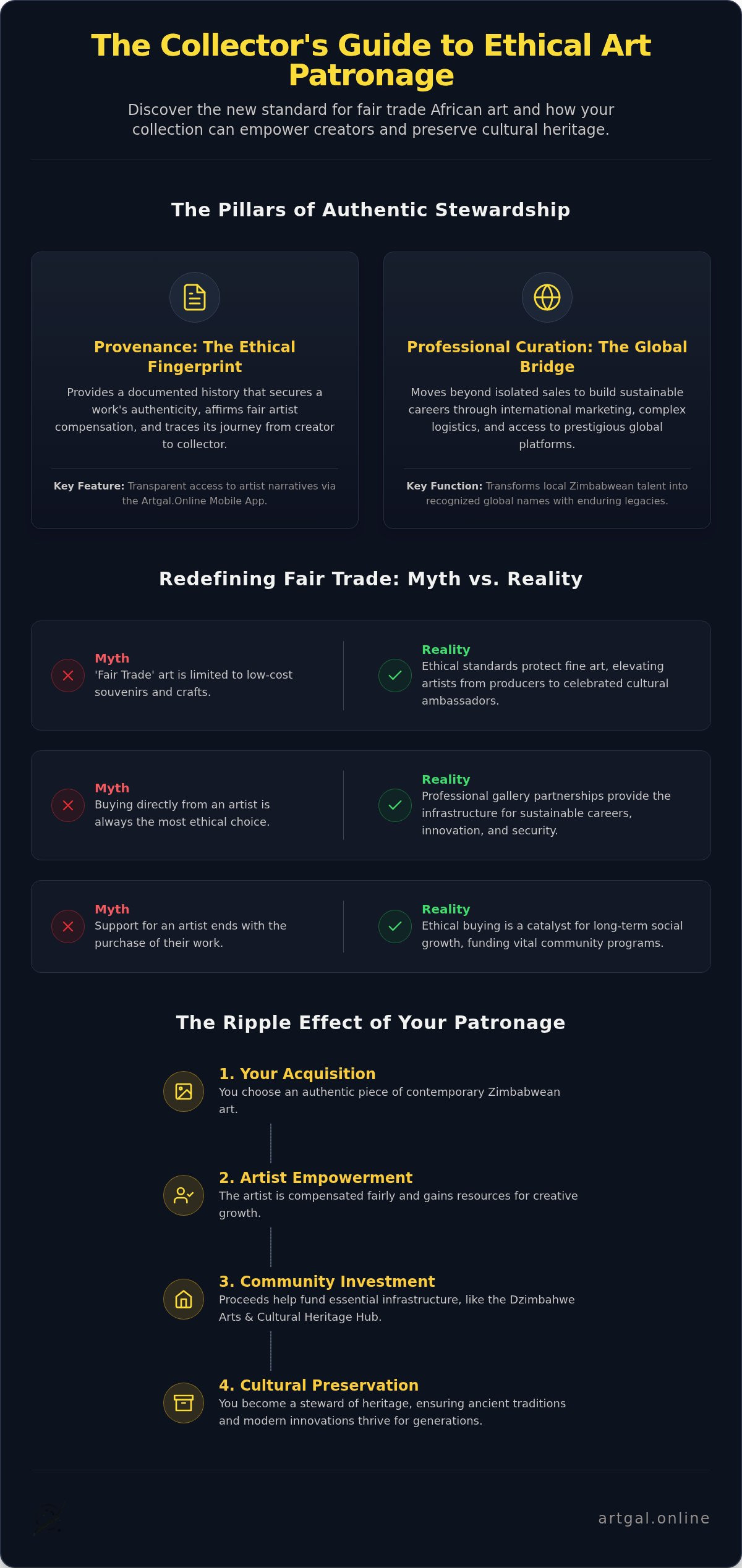
- Provenance Builds Confidence
- Fair Compensation Is Only the Beginning
- Tsika Dzedu: Giving Young Artists a Reason to Dream
- Artgal Zim Center: Creating a Place for Art to Grow
- From Zimbabwe to the World
- Supporting Artists Can Strengthen Communities
- Preserving Culture Without Freezing It in Time
- The Collector Becomes Part of the Story
- Our Approach at Artgal.Online
- More Than Owning an Artwork
- Frequently Asked Questions
Know the Artist Behind the Work
One of the most important differences between collecting original art and buying a decorative object is knowing the person who created it. This appreciation for the creator's expertise is a shared value among those who seek out fine craftsmanship; for example, when you discover Brilliant Diamonds Fine Jewelers, you find that same emphasis on custom artistry and the personal story behind a high-quality engagement ring.
Zimbabwe has an extraordinary artistic tradition, but African art has too often been marketed internationally without giving enough attention to the individual artist.
We want that to change.
When someone acquires a work through Artgal.Online, the artist’s name, background and artistic practice should be part of the experience.
A collector should know not only what they are buying, but also who created it and what lies behind the work.
Artists such as Keith Zenda, Tonderai Mujuru and Sampson Kuvenguhwa have each developed their own distinctive artistic language.
Keith Zenda explores Zimbabwean life, traditions, spirituality and history through painting and increasingly through experimental materials.
Tonderai Mujuru works across charcoal, pastel and oil, producing portraits, wildlife studies and contemporary works.
Sampson Kuvenguhwa developed his distinctive Mapiti sculptural style during a career extending over many decades.
Their work should not simply disappear under the broad description of “African art”.
They are individual artists with individual stories.
Provenance Builds Confidence
For serious collectors, provenance matters.
Knowing who created an artwork, where it came from and how it reached the collector provides confidence in its authenticity and preserves the history of the work for the future.
This is particularly important for Zimbabwean sculpture and contemporary African art, where works have sometimes travelled internationally without sufficient documentation about the artist who created them.
Professional galleries can help preserve that connection between artist and artwork.
At Artgal.Online, we want the artist’s identity and story to travel with the work.
Fair Compensation Is Only the Beginning
Responsible collecting obviously means that artists should receive fair payment for their work.
But sustainable support goes much further than one individual sale.
Artists also need opportunities to exhibit, build reputations, meet collectors and curators and have their work seen outside their immediate surroundings.
International marketing, professional photography, online exhibitions, documentation, shipping and participation on recognised international platforms all contribute to that visibility.
This is one of the areas where a gallery can work together with an artist.
The relationship should not be about taking control away from the artist. It should be about creating opportunities that can be difficult for an individual artist to develop alone.
Buying directly from an artist can be an excellent way of supporting them. Professional gallery representation can provide something additional: continuity, international promotion, provenance, exhibitions, logistics and access to new audiences.
Both can have an important place in an artist’s career.
Tsika Dzedu: Giving Young Artists a Reason to Dream
One of the projects particularly important to us is Tsika Dzedu, our Zimbabwean exhibition and competition centred around culture, tradition, identity and artistic creativity.
The purpose is not simply to organise another art competition.
It is about giving artists — and particularly younger artists — something to work towards.
It gives them the opportunity to create a work, enter a competition, exhibit alongside others, receive feedback and perhaps win recognition for something that they have created themselves.
The reaction from the community has been extremely encouraging.
Parents, artists and members of the wider community understand that giving young people creative opportunities can provide motivation and a sense of purpose.
For a young person, having their artwork displayed publicly or being recognised by a jury can be enormously important.
It says:
Your talent matters. Your ideas matter. What you create has value.
That is particularly meaningful where opportunities for young people can be limited.
Drug and substance abuse has become a serious social concern in Zimbabwe, particularly among young people. Art alone cannot solve such a complex problem, and we would never suggest that it could.
But creativity, mentorship and participation can provide something valuable: constructive activity, discipline, a community and a goal to work towards.
A young person who begins painting seriously may start thinking about the next artwork, the next exhibition or the next competition.
They begin to have something to develop.
Something to be proud of.
And perhaps something to dream about.
That is one of the reasons why we believe Tsika Dzedu can become much more than an exhibition.
Artgal Zim Center: Creating a Place for Art to Grow
The Artgal Zim Center near Harare is intended to be more than a place where artworks hang on walls.
It should be a place where art can be exhibited, discussed, taught and discovered.
Established artists need places to present their work, but younger artists also need to see what is possible.
A young person who meets a professional artist, watches them work or sees their paintings exhibited may suddenly begin to imagine a completely different future.
That is why exhibitions, competitions, mentorship and community involvement belong together.
A gallery should not simply open its doors when there is something to sell.
It can also become a place where creativity develops.
From Zimbabwe to the World
A major objective of Artgal.Online is simple:
to make more people around the world aware of the quality of Zimbabwean art.
Zimbabwe is internationally famous for stone sculpture, but its artistic landscape is much broader.
There are painters, portrait artists, experimental artists, photographers and younger artists developing new approaches to Zimbabwean identity and contemporary African life.
Through Artgal.Online, the Artgal Zim Center, online exhibitions, international exhibitions and platforms such as Artsy, we are trying to create more opportunities for these artists to be discovered.
The internet has fundamentally changed what is possible.
An artist working in Zimbabwe can now have a painting seen by a collector in Switzerland, Britain, the United States, Germany, China or elsewhere in the world within seconds.
Our task is to help build the bridge between them.
Supporting Artists Can Strengthen Communities
Supporting an artist can also have an impact beyond the studio.
Several artists associated with Artgal.Online are active within their own communities.
Keith Zenda has developed the Zenda Art Centre in Gweru, where art, mentorship and community activities can take place.
Projects connected with him have included workshops for young women and girls and initiatives encouraging creativity outside Zimbabwe’s main artistic centres.
Tonderai Mujuru and his family have been involved with the Muju Family Care Clinic in Glenview, including projects connected with healthcare and improved access to water.
These activities are not a reason to buy a particular artwork.
The artwork itself must always stand on its own artistic quality.
But they demonstrate something important.
When an artist builds a sustainable career, the impact can extend well beyond that individual artist.
Preserving Culture Without Freezing It in Time
Projects such as Tsika Dzedu are also important because culture needs to pass from one generation to another.
But preserving culture does not mean freezing it in the past.
Contemporary Zimbabwean artists are responding to modern life.
They explore family, migration, spirituality, identity, environmental issues, urban life, rural traditions and social change.
Some work with traditional subjects.
Others experiment with entirely new materials and approaches.
Responsible collecting also means allowing artists the freedom to develop.
Collectors should not expect an artist simply to reproduce what an international audience imagines “African art” should look like.
Some of the most interesting artists are those who understand their heritage while developing their own contemporary voice.
That is also part of the purpose of Tsika Dzedu.
Young artists are encouraged to look at their culture and traditions, but to interpret them through their own eyes.
That is how culture remains alive.
The Collector Becomes Part of the Story
Collectors play an important role in an artist’s development.
Purchasing a work provides income, but it also provides recognition.
When a Zimbabwean artwork enters a collection in another country, it becomes part of a much larger cultural exchange.
The collector may show the work to friends, talk about the artist, share the artist’s story or perhaps eventually lend the work for an exhibition.
One artwork can introduce many other people to an artist they had never previously heard of.
That is how reputations gradually grow.
And that is why responsible collecting matters.
Our Approach at Artgal.Online
For us, responsible art collecting comes down to several straightforward principles:
Know the artist.
Respect the artist’s identity and story.
Preserve provenance and provide clear information about the artwork.
Pay artists fairly and help them develop sustainable careers.
Promote Zimbabwean art internationally rather than presenting it simply as a tourist product.
Create opportunities for younger and emerging artists alongside established names.
Use exhibitions and competitions such as Tsika Dzedu to provide motivation, recognition and opportunities for young people.
Support artistic and community initiatives that allow the effect of art to reach beyond gallery walls.
Most importantly, we believe Zimbabwean artists deserve to compete internationally on the quality of their work.
Not because the work comes from Africa.
Not because purchasing it should be seen as charity.
But because good Zimbabwean art deserves to be seen, discussed, collected and valued alongside good art from anywhere else in the world.
More Than Owning an Artwork
The best collections often begin with curiosity.
A collector sees one artwork and starts asking questions.
Who is the artist?
What influenced the work?
What else has the artist created?
What is happening in Zimbabwe’s contemporary art scene?
That curiosity is exactly what we hope to encourage.
Every time somebody discovers a Zimbabwean artist, visits an exhibition, follows an artist online, supports a competition or adds a Zimbabwean artwork to a collection, another connection is created between Zimbabwe and the wider world.
At the same time, every young artist who enters an exhibition such as Tsika Dzedu and begins to believe that their talent may have value gives us another reason to continue building these opportunities.
That is why, for us, art is about much more than buying and selling.
It is about artists.
It is about culture.
It is about communities.
And sometimes it is about giving a young person a reason to dream about a different future.
At Artgal.Online, our ambition is to create as many of those opportunities and connections as possible.
Because buying Zimbabwean art can be more than a purchase. It can become part of a much bigger story.
Frequently Asked Questions
What is responsible or ethical art collecting?
Responsible collecting means knowing who created an artwork, understanding its provenance and ensuring that the artist is treated fairly and properly recognised. It also means respecting the artist’s cultural background, intellectual property and individual artistic identity.
Why is provenance important when buying Zimbabwean art?
Provenance documents the history and authenticity of an artwork. It connects the collector to the artist and helps ensure that the identity and history of the work are preserved as it changes hands over time.
Is Zimbabwean art mainly stone sculpture?
No. Zimbabwe has an internationally recognised stone-sculpture tradition, but the country also has a vibrant contemporary art scene including painting, drawing, portraiture, photography, mixed media and experimental art.
Should I buy directly from an artist or through a gallery?
Both can support an artist. Buying directly can provide immediate income, while a professional gallery may additionally offer documentation, provenance, international marketing, exhibitions, shipping assistance and long-term career development. The important issue is that the artist is treated fairly and the artwork is properly represented.
What is Tsika Dzedu?
Tsika Dzedu is an exhibition and competition initiative promoting Zimbabwean culture, traditions and contemporary artistic interpretation. It creates opportunities for artists, including younger artists, to exhibit their work, compete, receive recognition and develop their talents.
How can art help young people in Zimbabwe?
Art can provide young people with creativity, discipline, mentorship, recognition and constructive goals. At a time when substance abuse and limited opportunities are serious concerns in many communities, artistic programmes can provide positive environments in which young people can develop confidence and a sense of purpose.
Does buying art through Artgal.Online support community projects?
The primary purpose of purchasing an artwork is to acquire and support the work of the individual artist. However, several artists connected with Artgal.Online are also active in community projects, education, healthcare and mentorship. Developing sustainable artistic careers can therefore sometimes have wider benefits within their communities.
What is the Artgal Zim Center?
The Artgal Zim Center near Harare is a physical space dedicated to presenting Zimbabwean art while also supporting exhibitions, competitions, artistic development, mentorship and community activities.
How does Artgal.Online promote Zimbabwean artists internationally?
Artgal.Online combines physical and virtual exhibitions, online promotion, international art platforms, collector outreach and partnerships to introduce Zimbabwean artists to audiences beyond Zimbabwe.
Why collect Zimbabwean art?
The best reason is the simplest one: because you connect with the artwork.
Zimbabwe offers an exceptionally rich and diverse artistic community. By discovering the artist behind the work, a collector can acquire something personally meaningful while also becoming part of the continuing story of Zimbabwean contemporary art.

Article by
Artgal.Online Editorial Team
The Artgal.Online Editorial Team works closely with artists, curators, researchers, and collectors to produce authoritative articles on contemporary African art, Zimbabwean culture, Shona sculpture, collecting, and exhibitions. Articles are reviewed in collaboration with the artists whenever possible to ensure authenticity and accuracy.
Disclaimer
The information presented in these articles, guides, infographics and educational resources is intended for general informational and educational purposes only. While every effort is made to ensure accuracy, completeness and relevance, Artgal.Online and its contributors do not guarantee that all information reflects the most current market conditions, auction results, valuations or scholarly opinions. Opinions expressed are those of the author and are provided to encourage appreciation, understanding and discussion of Zimbabwean and contemporary African art. This content should not be considered financial, legal, tax or investment advice. Readers are encouraged to conduct their own research and seek professional guidance where appropriate. References to artists, artworks, markets or collecting trends are intended for educational purposes and do not constitute a guarantee of future value or investment performance.


