

The Future of Provenance: Digital Verification and Direct-to-Artist Connections
For contemporary African art, provenance often begins with the artist.
When an artwork can be traced directly from a living artist’s studio through a recognised gallery to the collector, authentication becomes considerably more transparent. This is particularly important for contemporary Zimbabwean art, where many highly accomplished artists still have relatively limited international documentation.
Digital technology has created new possibilities for authenticating contemporary African art and documenting the history of individual works. Through virtual exhibitions, artist biographies, videos and augmented reality viewing tools, collectors can explore an artwork and learn more about the person who created it before making a decision.
At Artgal.Online, our direct relationships with Zimbabwean painters and sculptors allow us to document the artist, artwork title, dimensions, materials, origin and, where available, the work’s exhibition history.
Digital documentation does not replace traditional provenance. Instead, it adds another layer to it.
A certificate can confirm important details about an artwork, but photographs, exhibition records, artist interviews, videos and documented connections to the artist can help create a much fuller history of the work.
For contemporary art, this is particularly valuable because many of the artists themselves are still available to explain their ideas, techniques and intentions.
Rather than trying to reconstruct those stories decades later, we have the opportunity to record them now.
Digital Tools Supporting Provenance
The Artgal.Online Mobile App and our digital Artist Viewing Rooms give collectors access to artist biographies, artworks, exhibitions and, where available, video material about the artist and their work.
These tools do not themselves authenticate an artwork, but they can strengthen provenance by connecting an individual work to a documented artist, body of work and developing career.
High-resolution photography and digital viewing tools can also help collectors inspect details such as surface, texture, technique and materials before purchasing.
When authenticating contemporary African art, collectors should ideally look for several forms of supporting information:
- The artist’s name, artwork title, date, dimensions and medium clearly recorded.
- A certificate of authenticity or other written confirmation linked to the specific artwork.
- Photographic documentation of the artwork.
- A gallery invoice or other ownership and transaction record.
- Information about the artist’s biography and career.
- Exhibition history or publications where available.
- Confirmation of origin from the artist, their authorised representative, family or estate where appropriate.
No single document should necessarily be considered the entire provenance of an artwork.
The strongest provenance is usually created when several independent pieces of information support one another.
Why Direct Relationships With Living Artists Matter
One of the great advantages of collecting contemporary Zimbabwean art today is that many of the artists are still actively producing work.
Collectors therefore have opportunities that future generations may no longer have.
An artist can explain why a painting was created, what the symbols mean, what materials were used and where a particular work fits within their artistic development.
This connection can become an important part of the artwork’s history.
At Artgal.Online, we believe that these stories should be documented while they are still available.
For example, an artwork may eventually change hands several times. Decades later, the original artist may no longer be available to confirm its background. Good documentation created today can therefore become increasingly valuable in preserving the identity and history of that artwork.
This is especially important for African artists whose careers may historically have been less thoroughly documented than those represented by major international galleries and institutions.
Provenance Is More Than a Certificate
A certificate of authenticity is important, but a certificate alone should not automatically be considered proof.
Its value depends upon who issued it and whether the information it contains can be connected reliably to the artwork.
For contemporary art purchased directly from an artist or their recognised representative, establishing provenance can be comparatively straightforward.
The chain may simply be:
Artist → Gallery or Representative → Collector
Every additional piece of documentation strengthens that record.
Over time, the provenance might also include exhibitions, publications, catalogues, photographs, videos, previous owners or institutional records.
This creates what could be described as a living history of the artwork.
Authenticating Contemporary Zimbabwean Sculpture
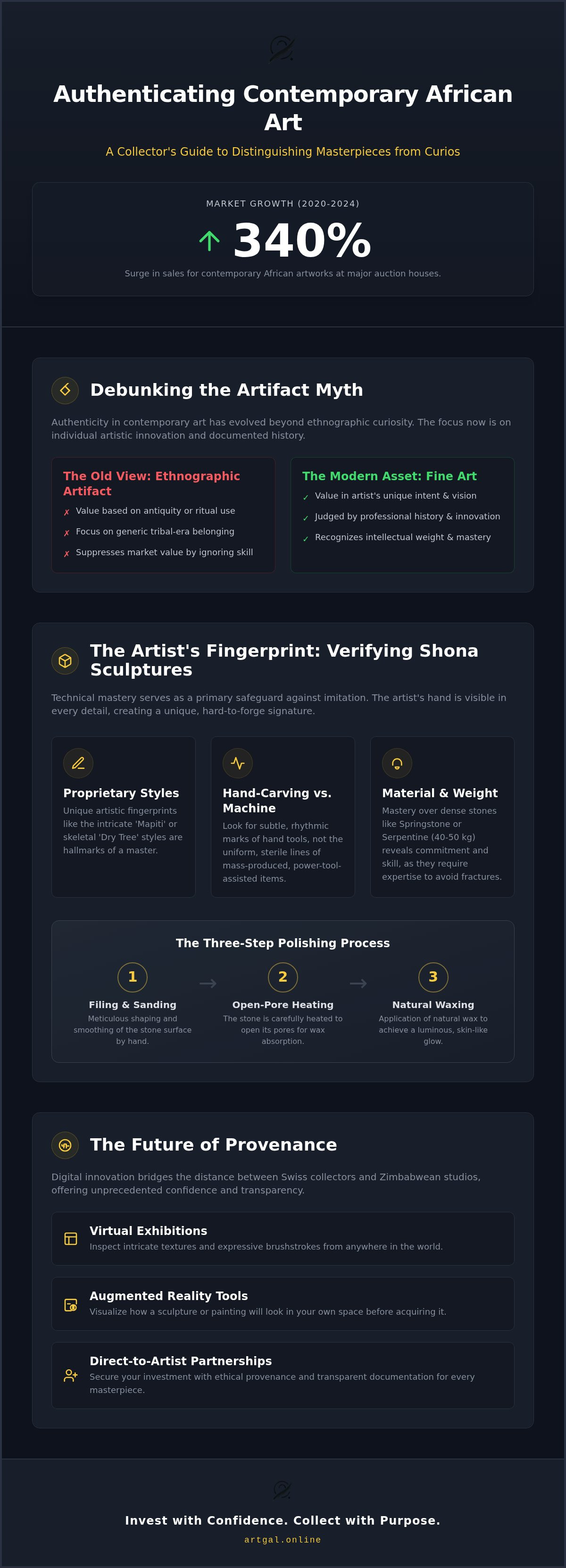
Zimbabwe has a remarkable tradition of stone sculpture, but distinguishing an important original work from a decorative or commercially produced sculpture requires more than simply examining the stone.
Material, technique, finish and artistic individuality can provide useful clues, but appearance alone is not enough to establish authenticity.
For works attributed to recognised Zimbabwean sculptors, collectors should look for documented provenance, information about the artist and the history of the individual work.
Where possible, confirmation should come from the artist, their family or estate, or from a gallery or representative familiar with their work.
Certain sculptors develop highly recognisable artistic languages.
For example, the work of Sampson Kuvenguhwa is associated with his distinctive Mapiti style. Knowledge of the artist’s technique and development can support an attribution, but stylistic resemblance should be considered together with provenance rather than used as proof on its own.
This becomes increasingly important as the reputation of an artist grows.
Once an artist’s work becomes valuable, copies, imitations and incorrect attributions may eventually appear in the market.
Good documentation created during the artist’s lifetime can therefore become extremely important.
Keith Zenda, Zendaism and Artistic Identity
A strong artistic identity can also contribute to the documentation of an artist’s work.
Zimbabwean artist Keith Zenda has developed an artistic philosophy he describes as Zendaism.
Zendaism brings together Zimbabwean heritage, cultural symbolism and wider themes including identity, sustainability, ancestry and contemporary life.
Recurring elements within Zenda’s work—such as traditional objects, symbolic figures, cultural references and reclaimed materials—form part of an increasingly recognisable artistic language.
For collectors, this wider body of work is important.
An artwork should ideally not be considered in isolation. Understanding how it relates to the artist’s other paintings, exhibitions, techniques and ideas can help establish its place within the artist’s career.
As Keith Zenda’s work continues to develop, documenting this artistic progression becomes part of the provenance of individual paintings.
The same principle applies to other emerging and established artists.
A well-documented artistic career helps future collectors, galleries and researchers understand where an artwork belongs within the development of that artist.
Digital Provenance and the Future Art Market
The art market is increasingly digital.
Collectors may discover an artist through social media, view an exhibition online, inspect a work through augmented reality and purchase it without ever physically visiting the artist’s studio.
This makes documentation even more important.
Digital provenance can include:
- Online exhibition records.
- Dated photographs of artworks.
- Artist interviews and videos.
- Published artist biographies.
- Gallery viewing rooms.
- Exhibition catalogues.
- Press coverage and articles.
- Records of previous ownership.
Together, these records can create a much richer picture than a certificate alone.
However, technology should support provenance rather than create the illusion of certainty.
High-resolution images can show details of an artwork, but they cannot alone prove who created it. An online biography can provide background, but it should be supported by genuine relationships and reliable records.
The combination of direct artist relationships, physical documentation and digital records provides the strongest foundation.
Authenticity, Value and Cultural History
Good provenance can have a direct effect on confidence in an artwork.
Collectors understandably want to know what they are buying, who created it and whether its history can be verified.
However, authentication should not be considered only in terms of financial value.
An artwork is also part of an artist’s personal history and, in many cases, part of a wider cultural history.
For contemporary Zimbabwean art, preserving that information is particularly important.
The stories behind artworks—family traditions, Zimbabwean culture, spirituality, rural and urban life, environmental questions, political history or personal experiences—may eventually become as important to researchers as the physical objects themselves.
When this information is properly documented, the collector becomes part of preserving that history.
Collecting While the Artists Can Still Tell Their Own Stories
Perhaps one of the most important advantages of collecting contemporary art is something very simple:
the artists are still here to tell us what their work means.
Their intentions do not have to be guessed.
Their stories do not have to be reconstructed decades later.
Their techniques, experiences and ideas can be documented directly from them.
At Artgal.Online, we believe this direct connection between artist, gallery and collector should be preserved wherever possible.
Paintings and sculptures can therefore be accompanied not simply by a certificate, but by a wider record of the artist, the artwork and its place within their career.
For collectors, this creates something valuable beyond a signature on a piece of paper: a traceable relationship between the artwork and the person who created it.
If you would like information about the provenance or background of a particular Zimbabwean artwork or artist represented by Artgal.Online, you can contact us.
We invite collectors to discover contemporary Zimbabwean art while its artists are still creating, developing and able to tell their own stories.
Frequently Asked Questions
Is contemporary African art a high-risk purchase without a certificate of authenticity?
A certificate of authenticity is useful, but it should ideally form part of a wider provenance record.
A certificate has greater value when it can be connected directly to the artist, gallery or recognised representative who issued it. Photographs, invoices, exhibition records, artist biographies and documented contact with the artist can provide additional evidence.
For contemporary African art, direct relationships with living artists can make establishing provenance considerably easier.
How can I tell the difference between an original Zimbabwean sculpture and a commercial souvenir?
Quality, material, technique and artistic individuality can provide useful clues, but appearance alone cannot reliably establish authenticity.
For sculptures attributed to recognised artists, collectors should look for documented provenance, information about the artist and, where possible, confirmation from the artist, family, estate or a knowledgeable representative.
Distinctive styles, such as Sampson Kuvenguhwa’s Mapiti work, can support an attribution but should be considered together with provenance rather than treated as proof by themselves.
Does buying through a gallery help with provenance?
Yes, provided the gallery maintains clear records and has a genuine relationship with the artists it represents.
A gallery can provide documentation such as invoices, artwork details, photographs, certificates and ownership records. When the gallery works directly with living artists, it may also be able to document the origin of individual works directly from the artist.
The location or nationality of a gallery does not itself authenticate an artwork. The quality and transparency of its documentation are more important.
What is Zendaism and how does it influence Keith Zenda's work?
Zendaism is an artistic philosophy developed by Zimbabwean artist Keith Zenda.
It brings together Zimbabwean heritage, cultural identity, symbolism and contemporary themes including ancestry, sustainability and the relationship between tradition and modern life.
Recurring symbols, materials and ideas within Zenda's paintings help create a recognisable artistic language. Documenting these developments also helps place individual paintings within the broader evolution of his career.
Can digital technology authenticate an artwork?
Digital technology can support authentication and provenance, but it should not normally be relied upon by itself.
Digital photographs, exhibition records, artist interviews, online catalogues and viewing rooms can help establish where an artwork appeared and how it relates to the artist's wider career.
The strongest provenance combines digital records with reliable physical documentation and a clear chain of ownership.
Why is provenance particularly important for living African artists?
Documentation created during an artist's lifetime can preserve information that might otherwise disappear.
Artists can identify their own works, explain their techniques and symbolism, provide dates and background information and describe where a work belongs within their career.
Creating these records today can make it considerably easier for future collectors, galleries, researchers and institutions to understand and authenticate the artist's work.
Artgal.Online Editorial Team
Article by
Artgal.Online Editorial Team

Article by
Artgal.Online Editorial Team
The Artgal.Online Editorial Team works closely with artists, curators, researchers, and collectors to produce authoritative articles on contemporary African art, Zimbabwean culture, Shona sculpture, collecting, and exhibitions. Articles are reviewed in collaboration with the artists whenever possible to ensure authenticity and accuracy.
Disclaimer
The information presented in these articles, guides, infographics and educational resources is intended for general informational and educational purposes only. While every effort is made to ensure accuracy, completeness and relevance, Artgal.Online and its contributors do not guarantee that all information reflects the most current market conditions, auction results, valuations or scholarly opinions. Opinions expressed are those of the author and are provided to encourage appreciation, understanding and discussion of Zimbabwean and contemporary African art. This content should not be considered financial, legal, tax or investment advice. Readers are encouraged to conduct their own research and seek professional guidance where appropriate. References to artists, artworks, markets or collecting trends are intended for educational purposes and do not constitute a guarantee of future value or investment performance.


