

Artgal.Online’s virtual viewing rooms allow visitors to move through digital exhibition spaces and experience artworks in a realistic gallery setting. Instead of presenting paintings and sculptures as isolated catalogue images, the rooms position them on walls and within exhibition spaces. This helps viewers appreciate their proportions, visual impact and relationship to neighbouring works.
These are not “African viewing rooms” as a separate type of exhibition. They are virtual viewing rooms featuring carefully selected works by Zimbabwean artists. The technology provides the setting; the artists and their artworks provide the identity, meaning and story.
Key Takeaways
- Artgal.Online’s virtual viewing rooms can be visited online from almost anywhere in the world.
- Visitors can move through realistic digital exhibition spaces rather than simply scrolling through a list of images.
- Artworks are displayed according to their recorded dimensions and proportions, providing a better understanding of their relative scale and impact.
- Each viewing room may focus on one artist, a connected body of work or a particular theme.
- Virtual viewing rooms complement physical exhibitions and make Zimbabwean art accessible to a wider international audience.
- Artist biographies, videos and stories can provide context without limiting the viewer’s personal interpretation.
Table of Contents
- What Is a Virtual Viewing Room?
- More Than an Online Catalogue
- Seeing Art in a Realistic Exhibition Setting
- Different Rooms, Different Stories
- Looking First, Reading Afterwards
- Connecting Zimbabwean Artists with the World
- How Virtual and Physical Exhibitions Work Together
- Can a Virtual Viewing Room Make Art More Personal?
- Continue Your Exploration with Artgal.Online
- Frequently Asked Questions
What Is a Virtual Viewing Room?
A virtual viewing room is a digital exhibition space that visitors can explore using a computer, tablet or smartphone. Artworks appear within a designed gallery environment, allowing visitors to move through the room and view both individual pieces and the exhibition as a whole.
Unlike a conventional webpage containing rows of artwork photographs, a viewing room creates a sense of place. It shows how artworks communicate across a wall, how a large painting dominates a space and how a series develops from one work to the next.
Artgal.Online uses this format to introduce Zimbabwean artworks to people who may be thousands of kilometres away from the artists or from the Artgal Zim Center and our other physical gallery locations.
More Than an Online Catalogue
An online catalogue is useful for finding information such as the artist’s name, artwork title, medium, dimensions and availability. A virtual viewing room has a different purpose: it encourages visitors to slow down and experience the art visually.
This becomes especially important when viewing a connected series. A single image may be powerful, but seeing several related works together can reveal changes in colour, technique, mood and subject. The viewing room gives each artwork its own presence while showing how it belongs within a wider artistic conversation.
Visitors remain free to follow their curiosity. They can move around the exhibition, return to a work that caught their attention and spend as much time as they wish with a particular painting or sculpture.
Those who want to learn more about the people behind the work can continue through the Artgal.Online Artist Directory.
Seeing Art in a Realistic Exhibition Setting
Artgal.Online’s viewing rooms present artworks within realistic, navigable exhibition spaces. The works are positioned according to their recorded dimensions and proportions, helping visitors understand their relative size and how they might appear when displayed on a wall.
This is valuable because measurements written beneath an image do not always communicate the physical presence of an artwork. A monumental canvas, an intimate portrait and a sculptural work create very different relationships with the viewer. Placing them inside a virtual room makes those differences easier to recognise.
The screen does not display an artwork at its literal physical size because this depends upon the visitor’s device and screen dimensions. However, the virtual room provides a realistic impression of proportion and allows meaningful comparisons between different works.
A digital experience cannot completely reproduce the surface, texture and material presence of an original artwork. Nevertheless, a well-designed viewing room provides far more context than a small standalone image and offers an excellent first encounter with the work.
Visitors wishing to see original artworks can explore our physical viewing rooms or contact Artgal.Online to arrange a visit.
Different Rooms, Different Stories
Each viewing room can have its own identity. Some concentrate on one artist, while others bring together works connected by subject, technique or cultural theme.
Artgal.Online’s presentations have included rooms devoted to subjects and collections such as Mushamukadzi, the Himba series, pet studies, Waste Portraits and An African Tale. This variety reflects the breadth of Zimbabwean creativity rather than attempting to reduce it to one visual style or a single definition of African art.
Portraiture, social observation, cultural memory, wildlife, experimentation and personal storytelling can all find their own space.
Visitors might begin with the paintings of Keith Zenda, explore the wildlife and portraiture of Tonderai Mujuru, or discover the vibrant contemporary voice of Florah Maphosa.
Artgal.Online also presents focused exhibitions through Artsy Viewing Rooms. These combine selected artworks with exhibition narratives, artist biographies and curatorial information, while allowing collectors to enquire about available works through an established international art platform.
Looking First, Reading Afterwards
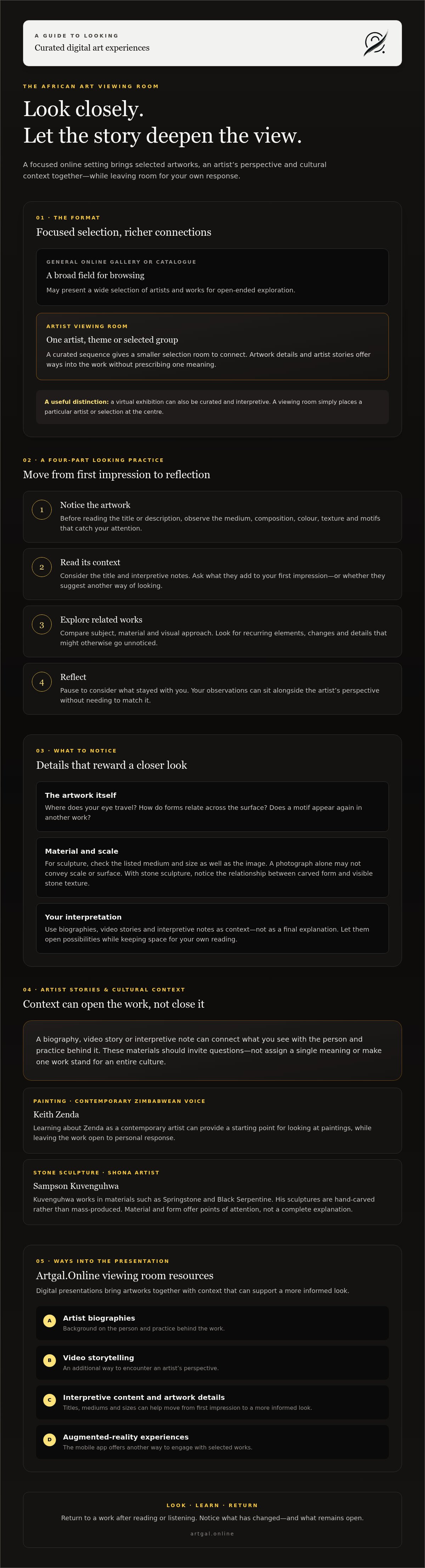
One of the pleasures of entering a viewing room is forming an immediate personal response. Before reading the title or interpretation, consider what first attracts your attention.
- Where does your eye go first?
- How do colour, composition and texture influence the atmosphere?
- Does the work feel intimate, peaceful, challenging or monumental?
- What changes when you see it beside other works by the same artist?
- Do recurring symbols or subjects become visible across the series?
After this first encounter, information about the artist, technique and inspiration can add another layer of understanding. Biographies, videos and written stories are most useful when they open new possibilities rather than provide one compulsory interpretation.
Art remains personal. Two visitors may look at the same work and discover completely different meanings—and both responses can be worthwhile.
Connecting Zimbabwean Artists with the World
For many Zimbabwean artists, geography remains a major obstacle to international visibility. Transporting an entire exhibition overseas is expensive, complicated and sometimes impossible. A virtual viewing room cannot remove every barrier, but it allows an exhibition to cross borders immediately.
Collectors, curators, educators and art lovers can encounter the work wherever they are. They can explore an artist’s practice before requesting further information, arranging a studio visit, discussing an exhibition or considering an acquisition.
This wider access is central to Artgal.Online’s mission: presenting Zimbabwean art professionally, giving artists space to tell their own stories and connecting their work with audiences beyond the country’s borders.
Our events and exhibitions archive shows how Artgal.Online artists are also being presented through physical exhibitions, international art fairs, museums, educational programmes and cultural collaborations.
Virtual viewing rooms therefore form part of a much wider effort. They do not merely place artwork online; they help build connections between artists, collectors, institutions and communities.
How Virtual and Physical Exhibitions Work Together
Digital and physical exhibitions should not be treated as competitors. Each offers something valuable.
A physical exhibition provides the irreplaceable experience of standing before an original artwork and observing its surface, materials, craftsmanship and presence.
A virtual viewing room provides access before, during and after a physical exhibition. It can introduce a show to visitors overseas, help people prepare for a visit and preserve the presentation after the gallery doors have closed.
The combination can also support education. Teachers and students can explore a viewing room together, compare artworks and discuss their stories without needing to travel. Collectors can return to works they are considering, while artists gain a lasting digital space for an important series or exhibition.
Can a Virtual Viewing Room Make Art More Personal?
Yes—particularly when it encourages active looking rather than passive scrolling.
Moving through an exhibition creates a sense of discovery. One artwork leads naturally to another, comparisons emerge and visitors can choose their own route through the presentation.
The digital environment also gives viewers privacy and time. There is no pressure to move on because another visitor is waiting, and the exhibition can be revisited whenever desired.
Artist interviews, biographies and interpretive texts can then provide context while leaving room for an individual emotional response.
The experience can continue beyond the viewing room. Through the Artgal.Online app and augmented-reality experience, selected artworks can be visualised in a home, office or other interior. This allows viewers to consider placement, proportions and visual impact within their own environment.
Continue Your Exploration with Artgal.Online
Artgal.Online’s virtual viewing rooms offer an accessible way to discover Zimbabwean artists within realistic exhibition environments.
Enter a room, move through it at your own pace and allow the artworks to speak before turning to their titles and stories.
The viewing room may be your first encounter with an artist, but it does not need to be the last. You can continue by:
- Exploring our artists and their stories
- Discovering the Artgal.Online app and augmented reality
- Browsing our international exhibitions and events
- Visiting our physical gallery locations
- Reading the Art Collectors’ Frequently Asked Questions
- Contacting Artgal.Online for information about a particular artist or artwork
If a work captures your attention, we can provide additional images, dimensions, availability, shipping information or details about commissioning an original artwork.
Explore the virtual viewing rooms and experience Zimbabwean art—wherever you are.
Frequently Asked Questions
What is a virtual viewing room?
A virtual viewing room is a navigable digital exhibition space in which artworks are displayed on walls or within a gallery-style environment. It allows visitors to experience the works together rather than only as separate catalogue images.
Are Artgal.Online’s viewing rooms only about African art in general?
No. “Viewing room” describes the digital exhibition format, not a category of art. Artgal.Online uses its viewing rooms primarily to present individual Zimbabwean artists, selected series and themed exhibitions.
Are the artworks shown at their real size?
The works are displayed according to their recorded dimensions and proportions within the virtual environment. Screen size and perspective mean that visitors are not seeing the literal physical size, but the room provides a realistic impression of scale and allows comparisons between different works.
How is a virtual viewing room different from an online shop?
An online shop is designed primarily to provide product details and facilitate a purchase. A viewing room is designed as an exhibition experience. It places artworks in context and allows visitors to explore visual relationships, themes and artistic development.
How is a viewing room different from a virtual exhibition?
The terms frequently overlap. A viewing room may focus closely on one artist or a connected series, while a virtual exhibition may bring together a wider selection around a theme. Both can use a navigable digital space to present art within an exhibition-style setting.
Can I learn about the artist while visiting?
Depending on the presentation, visitors may find artwork information, artist biographies, videos or accompanying stories. These resources provide context while allowing viewers to form their own response.
Do virtual viewing rooms replace physical galleries?
No. They complement physical galleries. They improve international access, extend the life of an exhibition and help visitors discover artists before encountering the original works in person.
Can I visit a viewing room using a mobile telephone or tablet?
Yes. The rooms can be accessed using common internet-connected devices, although the experience may vary according to screen size, browser and connection quality. A larger screen can make it easier to appreciate the complete exhibition layout.
Can I ask about purchasing or commissioning an artwork?
Yes. If a particular work or artist interests you, contact Artgal.Online for current information about availability, prices, worldwide shipping or commissions.
You can also visit our portrait commissions page if you would like an original portrait created from a photograph.

Article by
Artgal.Online Editorial Team
The Artgal.Online Editorial Team works closely with artists, curators, researchers, and collectors to produce authoritative articles on contemporary African art, Zimbabwean culture, Shona sculpture, collecting, and exhibitions. Articles are reviewed in collaboration with the artists whenever possible to ensure authenticity and accuracy.
Disclaimer
The information presented in these articles, guides, infographics and educational resources is intended for general informational and educational purposes only. While every effort is made to ensure accuracy, completeness and relevance, Artgal.Online and its contributors do not guarantee that all information reflects the most current market conditions, auction results, valuations or scholarly opinions. Opinions expressed are those of the author and are provided to encourage appreciation, understanding and discussion of Zimbabwean and contemporary African art. This content should not be considered financial, legal, tax or investment advice. Readers are encouraged to conduct their own research and seek professional guidance where appropriate. References to artists, artworks, markets or collecting trends are intended for educational purposes and do not constitute a guarantee of future value or investment performance.


